

On August 11, 2026, U.S. Citizenship and Immigration Services (USCIS) quietly posted an update permitting certain Salvadoran Temporary Protected Status (TPS) beneficiaries to demonstrate continued work authorization by presenting their Employment Authorization Document (EAD) together with an Individual Notice that USCIS will issue. While welcome, the update arrives weeks after most Salvadoran TPS-based EADs expired, and after some employers may already have taken adverse employment action based on those expirations. Later, on August 12, USCIS distributed the update more broadly by email.
Background: The Extension Landscape
Generally, an EAD issued in connection with TPS may be extended in one of three ways:
1. Federal Register Notice: USCIS may announce, as it did previously for El Salvador, that EADs bearing Category Codes A12 or C19, issued to beneficiaries of a particular TPS designation and bearing specified expiration dates, are automatically extended through a designated date.
For example, USCIS published a notice in the Federal Register on January 17, 2025, announcing that A12 or C19 EADs bearing March 9, 2025, June 30, 2024, Dec. 31, 2022, Oct. 4, 2021, Jan. 4, 2021, Jan. 2, 2020, Sept. 9, 2019, or March 9, 2018 were automatically extended until March 9, 2026.
2. Timely Filing Extension: If a TPS EAD holder timely files to renew their TPS-based EAD, they were eligible for an extension through the earlier of (1) 365 days, or (2) July 22, 2026, the end of the TPS designation period, so long as the Form I-765 was received prior to October 30, 2025.
For example, a Salvadoran TPS beneficiary who presented an EAD with an expiration date of 3/9/2025 and Form I-797C showing timely Form I-765 filing was capped at July 22, 2026.
3. Individual Notice: In certain limited circumstances, USCIS will issue individualized notices extending the validity of select EADs.
Lucky Number 3: USCIS is issuing Individual Notices
USCIS is issuing Individual Notices to certain Salvadoran TPS-based EAD holders. Impacted individuals can present their EAD along with the Notice (that is being delivered electronically and in hard-copy form) as evidence of work authorization through September 9, 2026.
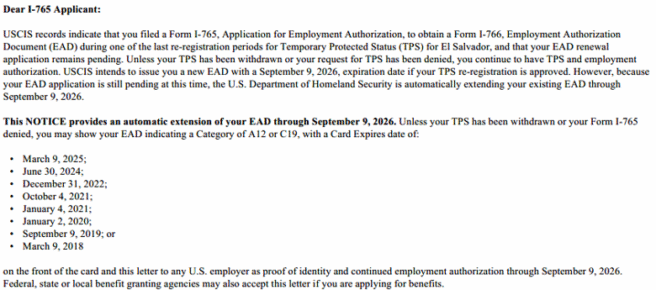
Per USCIS:
If you continue to be eligible for TPS but haven’t received your renewal EAD with the category codes A-12 or C-19 and your TPS-based EAD application is still pending, USCIS will send you a Notice regarding an EAD extension to September 9, 2026 by mail and electronically if you have a myUSCIS account.
Unless your TPS has been withdrawn or your Form I-765 denied, you may show your EAD indicating a Category of A12 or C19, with a Card Expires date of March 9, 2025; June 30, 2024; December 31, 2022; October 4, 2021; January 4, 2021; January 2, 2020; September 9, 2019; or March 9, 2018 on the front of the card and the Notice to any U.S. employer as proof of identity and continued employment authorization through September 9, 2026. Federal, state or local benefit granting agencies may also accept this Notice if you are applying for benefits.
What Employers Should Do Now
Importantly, employers are not required to rehire employees who were terminated because they could no longer provide evidence of continuing work authorization. We anticipate that many employees who were terminated because their work authorization extensions expired on July 22, 2026 will seek to regain their employment.
Employers should continue reverifying pursuant to their already-established procedures. Employees who could not evidence continuing work authorization and who were suspended should be made aware of this new development in hopes that they will receive the notice and can return to work. Employers should ensure that similarly situated employees are treated in the same manner to minimize discrimination risk and maintain compliance with the anti-discrimination provisions of the Immigration and Nationality Act.
Because the notice serves as evidence of continued employment authorization through September 9, 2026, employers should ensure that any reverification is documented consistent with USCIS’s Form I-9 and E-Verify specific instructions on how a new hire or extension should be recorded.
When completing the “Expiration Date (if any)” fields on Form I-9, input in Section 1 and Section 2 “Sept. 9, 2026” along with a note in the Additional Information box. Employers may download the Alert and TPS El Salvador Automatic Employment Authorization (EAD) Extension webpage and attach them to Form I-9, along with the USCIS notice. When completing a case in E-Verify, enter the expiration date of “Sept. 9, 2026,” from the Form I-9.
The group advises on Form I-9 and E-Verify compliance; ICE inspections and worksite enforcement matters; internal immigration assessments and I-9 audits; DOL immigration-related wage and hour investigations; H-1B compliance; DOJ IER and OCAHO anti-discrimination matters, including enforcement actions involving allegations that U.S. workers were disadvantaged in favor of foreign workers; and deemed export and ITAR compliance issues. The team combines deep immigration compliance and investigations experience with Seyfarth’s nationally recognized labor, employment, and litigation capabilities. For timely updates on immigration developments, subscribe to Seyfarth’s immigration blog, Through the Immigration Lens.